From “Going It Alone” to “Assembly-Line Production” — The Process Advantages and Efficiency Revolution of Progressive Die Stamping
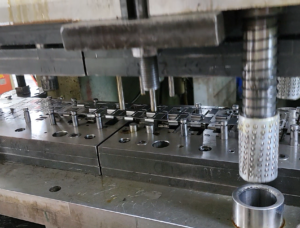
In the world of stamping manufacturing, dies are often regarded as the “mother of industry.” Among the various types of stamping dies, the progressive die (Progressive Die) stands out as a true “efficiency champion,” thanks to its ability to perform multiple operations continuously, achieve high production rates, and support highly automated manufacturing.
For manufacturers seeking higher productivity, consistent quality, and better cost control, progressive dies are more than just a way to combine several stamping operations into a single die. They represent an integrated manufacturing approach that combines multiple processes through continuous feeding, multi-station coordination, and simultaneous forming. In this way, traditional single-operation stamping is transformed into a highly continuous “assembly-line” production process.
1. The Core of Progressive Dies: Coordinating Multiple Operations in One Die
A progressive die is designed around the principle of “division of labor and coordination.”
Unlike single-operation dies, where workpieces typically need to be transferred between different dies or stations, a progressive die divides the manufacturing process into a series of operations based on the geometry and forming requirements of the part. These operations may include punching, trimming, bending, drawing, flanging, and forming. They are then arranged sequentially along the feeding direction of the strip material.
During each press cycle, the feeding system advances the strip by a predetermined pitch. At the same time, different stations perform their respective operations simultaneously. As the strip continues to move forward, each part passes through the required operations in sequence. At the final station, the finished part is separated from the carrier.
In other words, a progressive die does not manufacture a single part from beginning to end at one station. Instead, different stations simultaneously process parts that are at different stages of production.
The greatest advantage of this approach is that multiple operations that would otherwise have to be performed sequentially can be converted into a continuous and parallel production process.
2. The Key Advantage: Significantly Higher Production Rates
The most obvious advantage of progressive dies is their high production efficiency.
In single-operation stamping, a workpiece usually needs to be removed, transferred, and repositioned after each operation. As the number of operations increases, so do the intermediate handling steps, equipment requirements, labor input, and transfer time.
A progressive die integrates these processes into a continuous production system. As long as the press and feeding system operate reliably, multiple stations can perform their respective operations simultaneously.
For example, a part may require punching, trimming, bending, and forming. With conventional single-operation dies, these processes generally have to be completed separately. With a progressive die, however, they can be performed continuously at different stations within the same die.
For products such as electronic terminals, connectors, and small precision metal components that are suitable for high-speed stamping, a high-speed press equipped with a progressive die can achieve very high production rates. Production speed is commonly measured in SPM (Strokes Per Minute). Depending on the part geometry, material, die design, and press specifications, production rates of dozens or even hundreds of strokes per minute can be achieved.
More importantly, the efficiency of progressive dies does not come solely from high stamping speeds. It also comes from reducing intermediate handling and manual operations.
3. High Automation: Continuous Production from Coil Stock to Finished Parts
Progressive dies are naturally well suited for integration with automated feeding systems.
A typical production line may consist of a decoiler, straightener, feeder, stamping press, and part collection system. The material enters the line as coil stock and passes through uncoiling, straightening, and precision feeding before entering the die. The stamping operations are then performed continuously, and the finished parts are collected automatically.
Depending on the product and equipment requirements, different feeding systems can be used, including air feeders, roller feeders, and NC servo feeders.
Under highly automated production conditions, operators do not need to repeatedly pick up, transfer, and position individual parts. This reduces labor requirements while also minimizing positioning errors and safety risks caused by manual handling.
In this sense, progressive dies represent a fundamental change in the production model:
Instead of having operators move from part to part, the parts move automatically through the entire manufacturing process.
This is one of the key reasons why progressive dies are so effective for high-volume production.
4. Carrier and Pitch: Critical Factors for Stable Progressive Die Operation
Although progressive dies emphasize automation and high efficiency, they are also significantly more demanding to design than conventional single-operation dies.
Among the many design considerations, carrier design and feed pitch are particularly important.
The carrier can be viewed as the “bridge” connecting the material between different stations. During continuous feeding, the carrier must have sufficient strength and rigidity to transport the strip reliably while also accommodating forming operations, the overall layout, and final part cutoff.
If the carrier is poorly designed, problems such as strip deformation, unstable feeding, part misalignment, and even die jams may occur.
The feed pitch determines the distance the strip advances during each cycle. In multi-station progressive stamping, feeding accuracy directly affects the relative positioning between different operations.
In actual production, feeding systems are typically combined with features such as side cuts and pilot pins to position and correct the strip accurately.
This is particularly important for products such as electronic connectors and precision terminals, where feeding stability, pilot positioning accuracy, and die manufacturing accuracy are critical. It is important to note that feeding accuracy, die positioning accuracy, and final part dimensional accuracy are not exactly the same thing. Final dimensional accuracy is also influenced by material properties, die design, press rigidity, machining tolerances, and the overall stamping process.
5. Strip Layout: Efficiency Is Not Just About Stamping Speed
When people talk about progressive dies, the first thing that often comes to mind is high production speed. In high-volume manufacturing, however, material utilization is also an important factor in determining overall production costs.
Progressive dies typically use continuous strip or coil stock, so the strip layout has a direct impact on material utilization.
Engineers must consider the part geometry, sequence of operations, carrier configuration, and die strength when developing the layout. By using appropriate arrangements such as single-row, multi-row, or staggered layouts, it is possible to minimize scrap and reduce the amount of material used for bridges and carriers while still meeting process requirements.
Of course, higher material utilization is not always better.
If the carrier or material bridges are made too narrow in an attempt to reduce scrap, the strip may become too weak, resulting in unstable feeding and potentially reducing die life. Therefore, an excellent progressive die layout is essentially a matter of finding the best balance among material utilization, feeding stability, die life, and product quality.
6. Why Is the High Initial Investment Still Worthwhile?
One of the major barriers to progressive dies is their relatively high initial investment.
Compared with conventional single-operation dies, progressive dies typically have more stations, more complex structures, and higher requirements for machining, assembly, and tryout. Their manufacture may involve precision grinding, wire EDM, jig grinding, and strict heat-treatment processes. As a result, they place higher demands on die materials, manufacturing equipment, and technical expertise.
Therefore, a progressive die is not necessarily the best choice for every stamping application.
If production volumes are low, orders are unstable, or the part geometry is unsuitable for progressive processing, the high initial investment may not be recovered within a reasonable period.
For products with stable demand, high production volumes, and geometries well suited to progressive stamping, however, the situation is very different.
Once the die enters mass production, its cost can be distributed across a large number of parts. At the same time, automated feeding reduces manual labor, multi-station processing reduces transfer operations, and high-speed stamping further improves equipment utilization.
As production volume increases, the die cost and labor cost allocated to each individual part decrease accordingly. This is the core of the economies of scale offered by progressive stamping.
7. The Essence of Progressive Stamping Is an Upgrade in Manufacturing
The transition from single-operation dies to progressive dies may appear to be simply a change in die structure, but in reality, it represents a fundamental change in the entire production philosophy.
Traditional stamping is more like “going it alone”: one operation is completed before the workpiece is transferred to the next operation. Progressive stamping, by contrast, is more like a highly coordinated “assembly line.” Each station performs its designated task while the material continuously moves forward, allowing different stages of production to take place simultaneously.
The advantages of progressive dies can therefore be summarized in four key characteristics:
High efficiency, high automation, high consistency, and low unit cost.
At the same time, these advantages come with higher requirements for upfront design and manufacturing.
Therefore, progressive stamping is not simply about achieving the highest possible speed. It is about optimizing the overall balance among part geometry, production volume, material utilization, equipment capability, die life, and manufacturing cost.
For high-volume, stable, and precision-oriented stamping applications, the transition from single-operation processing to continuous, automated, and large-scale production represents the true efficiency revolution brought about by progressive dies.
From “going it alone” to “assembly-line production,” progressive dies change more than just stamping speed. They transform the way manufacturers organize production, control costs, and achieve large-scale, reliable delivery.